Sleepover Season: Tracing the Two-Week Path From One Birthday Cake to a Whole Household of Pinworms
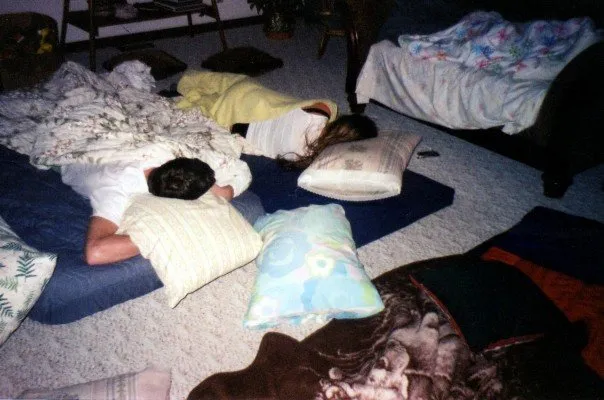
Photo: User:Hmwith, Public domain, via Wikimedia Commons
The Arithmetic of an Overnight Party
Pinworms (Enterobius vermicularis) are arguably the most successful parasite in American childhood. The CDC estimates them among the most common helminth infections in the United States, and their transmission math is unforgiving: a female pinworm deposits thousands of microscopic eggs around a child's anus at night. The itching that follows transfers those eggs to fingers, pajamas, and bedding. From there, any shared surface becomes a relay station.
Now put that biology in a room with six sleeping bags, one bowl of popcorn, and a bathroom shared by a dozen small hands. What happens over the following ten to fourteen days is less an outbreak than a slow, invisible relocation.
The Chain, Step by Step
Hour one to hour eight. The party itself. Sleeping bags laid side by side, pillow forts, a shared laptop under a blanket. Pinworm eggs can survive on surfaces for up to two to three weeks. A child who scratched in their sleep leaves viable eggs on a sleeping bag's zipper, a throw blanket, the arm of the couch.
Days one through three. Guests go home. Eggs on backpacks, hoodies, and stuffed animals ride along. Most families will not notice anything, because symptoms have not started. This is the critical blind spot: pinworm has a latency period, and disclosure at the party's end is often impossible because the host family genuinely does not know yet.
Days four through six. The originally infected child, or newly exposed guests, begin experiencing nocturnal anal itching. Sleep quality dips. Parents notice restlessness or irritability, often misreading it as a growth spurt or screen-time hangover.
Days seven through fourteen. The reinforcement loop. An infected child scratches, touches the bathroom doorknob, the toothbrush handle, the breakfast cereal pour spout. Handwashing gaps — notoriously common in the under-ten demographic — complete the cycle. Because eggs are ingested to start a new infection, one household member becomes four. Adults are not exempt; they are simply better at hiding the itching.
A Parent's Etiquette Guide
Navigating the social side of pinworm is often harder than treating it. There is no requirement to broadcast a diagnosis, but there are reasonable norms worth adopting.
When to disclose. If your child is diagnosed within a few days of hosting or attending a gathering, a brief, non-dramatic message to other parents is appropriate: "We just learned our child has pinworms — very common, easily treated. You may want to keep an eye out." Pinworm carries no moral failing and no serious health risk; framing it like head lice, which most parents already handle matter-of-factly, keeps panic out of the group chat.
When to treat preemptively. If a guest parent notifies you of exposure, you have two defensible options: wait and watch for symptoms over the next two weeks, or treat everyone in the household at once. Because mebendazole is inexpensive and available over the counter in many pharmacies — and through direct-to-consumer retailers — many physicians suggest treating the whole household when exposure is confirmed, since reinfection between untreated family members is the number one reason pinworm drags on.
When to reschedule. If your household is in active treatment, hold off on hosting for a week. Pair the medication course with a hot-water wash of all bedding and a thorough vacuum of sleeping areas. After that, you are cleaner than most households on any given Tuesday.
Hosting a Parasite-Safer Gathering
None of this requires turning a birthday party into a biohazard drill. A few low-friction habits cut transmission substantially:
- Individual sleeping setups. Space sleeping bags a few feet apart rather than in one communal pile.
- A handwashing checkpoint before food. Frame it as a party ritual — cake comes after hands, no exceptions, adults included.
- Keep nails short and discourage nail-biting snacks. Eggs lodge under fingernails; short nails are a genuinely underrated defense.
- Wash shared textiles after the party. Sleeping bags, pillowcases, and blankets go straight into a hot cycle rather than back into the closet for next time.
- Skip the shared-bath towel. Paper towels for one night cost almost nothing.
The Bigger Picture
Pinworm thrives not on dirtiness but on proximity — the same closeness that makes sleepovers and birthday parties valuable parts of childhood. The goal is not to eliminate the gathering; it is to shorten the transmission chain with a handful of deliberate choices and to respond quickly when the inevitable itch shows up.
For households that do end up treating an infection, the good news is that mebendazole remains one of the most affordable and well-tolerated antiparasitic medications available. A single course, repeated two weeks later to catch any newly hatched worms, resolves the vast majority of cases. Fast, affordable access to treatment means a pinworm diagnosis is an inconvenience measured in weeks — not a crisis measured in anything at all.
The party guest nobody invited will keep showing up. But with a little planning, your family can send it home early.